Mia Solitaire - Fun Card Game
- 4.8
- Rating
- 1.00M
- Installs
- Free
- Price
 Analysis by App-foxy
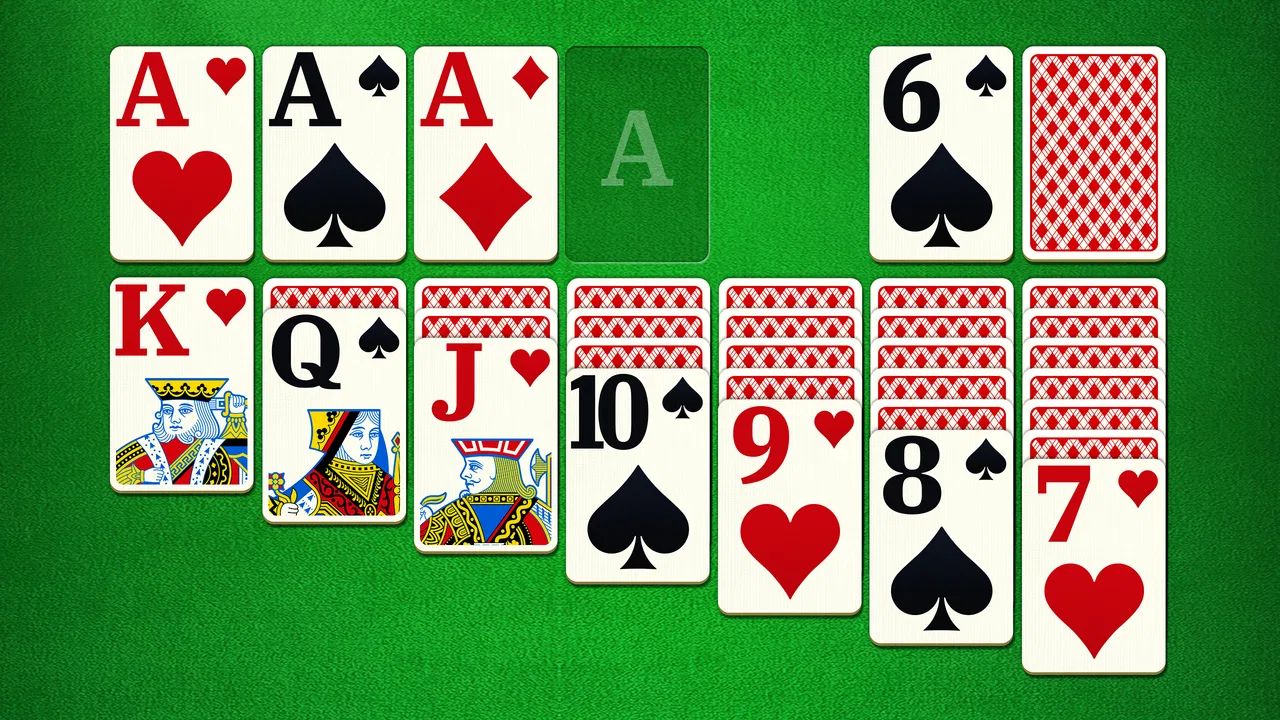
I usually know within the first few minutes whether a solitaire game is going to feel comfortable or merely familiar. With Mia Solitaire, the first impression comes from its unusually readable presentation. The cards and interface are designed around large fonts and large card faces, so the basic action is easy to understand: find a playable card, tap or move it, watch the layout open up, and decide what to do next. It is a simple loop, but the redesign makes that loop less tiring than many traditional solitaire apps.
This is a free card game from Mia Game, aimed at people who want classic solitaire without needing a connection. It sits in the casual, pick-up-and-play part of the card category rather than trying to turn solitaire into a complicated strategy product. I found it most appealing during short breaks, when I wanted something quiet that still gave me a small decision to make every few seconds. The game is rated for Everyone, and its straightforward presentation should be approachable for older players, casual users, and anyone who prefers clarity over decoration.
How the solitaire loop feels in everyday use
I find the everyday rhythm easiest to judge by noticing what happens between moves: a card becomes available, the layout changes, and I decide whether to keep working the same route or reconsider. That makes the game a good fit for brief pauses, but it also means a stalled board can feel like a natural stopping point rather than a problem to solve at any cost. In the next section, I’d look at the small checks that help a session start smoothly.
You May Also Like

 Blood Strike: 2.5 Anniversary
Blood Strike’s Loadouts Turn Every Drop Into a Tactical Gamble
A close look at Blood Strike’s custom loadouts: how fast access to signature weapons reshapes its battle royale rhythm, rewards preparation, and narrows the gap between fights.

 Pandora - Music & Podcasts
Pandora’s Music Is Easy to Start, but Harder to Recover
Pandora’s strength is its low-effort path from a seed to a station. Its weak spot is how much confidence it asks you to place in connection, setup, and quiet recovery.

 8 Ball Pool
 Is Built on Rivalries, Rematches, and Routine
A close look at the rivalries, rematches, shared routines, and unanswered safety questions that turn a quick pool match into a persistent mobile community.

 Samsung Music
’s Quiet Strength Is Playing What You Already Own
Its reach comes less from spectacle than from dependable access to a personal library. That simplicity is both the app’s strongest retention engine and its ceiling.

 AccuWeather: Weather Radar
AccuWeather Review: A Quick, Clear Forecast for Everyday Decisions
For everyday plans, the best forecast is the one you can understand quickly. AccuWeather makes rain timing, radar, and local conditions easy to act on, with a few trade-offs.

 Hill Climb Racing
Why Hill Climb Racing Still Turns Crashes Into One More Run
A tiny car, a bumpy hill and one more upgrade: Hill Climb Racing keeps resurfacing because its simple chaos makes every near-miss feel personal.
More From Our News Desk



The first action is clear, and that matters
The best place to judge this game is not the opening screen but the first move. Solitaire can become irritating when cards are cramped, labels are difficult to read, or the controls make a basic move feel uncertain. Here, the large-card approach gives the board a calmer rhythm. I can look at the layout, identify a possible move, and act without spending time deciphering the interface.
That matters especially on a phone held in one hand. A typical use case for me is waiting for an appointment or taking a short break from work. I do not want a long tutorial or a game that demands full concentration immediately. I want to open it, understand the current position, and make a move before deciding whether to continue. Mia Solitaire fits that moment because the central task is visible almost at once.
The first action is also a useful test of whether this is the right kind of game for you. If you enjoy classic solitaire because of the quiet process of sorting cards, the layout gets out of the way. If you expect a modern card game with elaborate missions, competitive play, or a large collection of modes, this experience may feel intentionally plain. Its appeal comes from refining the familiar activity, not from rebuilding it into something unrecognizable.
Each move creates a readable feedback rhythm
Solitaire works because every decision produces a small piece of information. A move either exposes a hidden possibility, clears space, or shows that a different order would have been wiser. In this game, the large visual treatment helps that feedback arrive quickly. I can see the result of a move without leaning toward the screen or searching through tiny card symbols.
That creates a useful rhythm: inspect the tableau, make a move, reassess the available cards, and continue. The reward is not only reaching the end of a deal. It is the gradual feeling that the board is becoming more understandable. A blocked column may open, a useful sequence may become available, and the next choice appears naturally from the previous one.
I particularly like this rhythm for low-pressure play. There is enough uncertainty to keep me thinking, but the game does not require the kind of attention I would give a competitive multiplayer title. I can pause mentally between moves, which makes it suitable for a short rest rather than another demanding task.
The trade-off is that solitaire’s feedback can become repetitive if you need constant novelty. The same basic pattern of arranging, exposing, and clearing cards is the attraction here, but it is also the boundary. Players who lose interest when a game does not introduce new mechanics may find the loop too familiar after several sessions.
Why a small reward can lead to another deal
The reward structure in a classic solitaire game is mostly self-contained. You are not necessarily chasing a story or building a character. The satisfaction comes from turning a messy arrangement into an orderly one and from recognizing that your earlier choices made the finish possible. Mia Solitaire benefits from keeping that reward close to the action instead of burying it under a busy presentation.
For me, the strongest reward is the moment a previously awkward layout starts to cooperate. I may spend several turns looking for a route, then uncover a card that changes the entire board. That discovery gives the session a gentle lift. It is not dramatic, but it is enough to make the next move feel earned.
The game’s free entry also makes it easy to try without commitment. There are in-app purchases ranging from $0.99 to $10.99 per item, so anyone who wants to keep spending controlled should treat the free version as the starting point and check purchase prompts carefully. I would not choose this game primarily for its monetization; I would choose it for the offline-friendly, readable solitaire experience, then decide whether any optional purchase is worthwhile for my own habits.
One practical tip is to use the reward moment as a natural stopping point. If I finish a deal, I can close the game feeling that the break had a clear end. If I lose or reach an awkward position, the desire to try again can be stronger, because I already understand which part of the layout caused trouble. That reset is the engine behind the “one more game” feeling.
The reset is quick enough for short sessions
A good mobile solitaire game needs to make starting again feel effortless. The appeal is often not a long uninterrupted play period, but a series of small sessions: one deal on a commute, another while waiting for food, or a few minutes before bed. Since the game does not require Wi-Fi, it is especially convenient in places where a connection is unreliable or unavailable.
Offline play changes how I think about it. I can use it as a dependable fallback instead of checking whether a network is available first. That makes it more useful than a solitaire app built around online events or connection-dependent content. It also keeps the purpose simple: open the game, play, finish or reset, and put the phone away.
The reset loop has a psychological advantage too. A new deal feels like a clean experiment rather than a continuation of a complicated system. I can change my approach, be more careful with exposed cards, or simply accept that the previous layout did not work out. This is one of the less obvious strengths of a classic card game: the restart is not a punishment; it is an invitation to test a different sequence.
Still, players should not expect every session to feel equally satisfying. Solitaire naturally includes boards where progress slows or where the available choices are limited. The large cards make those situations easier to read, but they cannot remove the underlying uncertainty of the game. If you prefer guaranteed progress, a puzzle with fixed solutions may be a better match.
Large cards are more than a cosmetic change
The most meaningful design decision here is the emphasis on large fonts and large cards. That sounds simple, but it affects the whole experience. A card game is built from symbols, ranks, colors, and positions. When those elements are easier to see, the mental work shifts away from reading the screen and back toward making decisions.
I can see this being valuable for people who find dense mobile interfaces tiring, including anyone who plays with a larger display setting or simply wants less visual strain. It is also helpful for a player who is new to mobile solitaire and does not want to learn controls while simultaneously trying to understand the rules.
The downside is that larger elements can make the board feel less compact. Players who are used to fitting a lot of information into a small space may prefer a more traditional, tightly arranged layout. That is not a flaw so much as a clear design choice. Mia Game has prioritized legibility and comfort over maximum information density.
My advice is to judge the presentation by the kind of attention you want to give the game. For relaxed play on a phone, the spacious approach is a strength. For someone who likes scanning many possibilities at once and playing rapidly, it may feel slower because the visual experience is deliberately less crowded.
Where it fits among usual solitaire alternatives
Compared with a generic solitaire app that focuses on visual effects, this one feels more practical. The appeal is not a parade of distractions but a board that lets the card arrangement speak for itself. Compared with a highly competitive card game, it is much less stressful because there is no need to react to another player in real time. Compared with a paper deck, it offers the convenience of automatic layout and a portable board, while keeping the familiar logic of arranging cards.
That comparison also clarifies who should skip it. I would not recommend it to someone looking for multiplayer competition, deep deck-building, or a campaign with a strong sense of progression. I would also steer away players who need a constant stream of new challenges. This is best understood as a focused solitaire companion, not an all-purpose card-gaming platform.
On the other hand, it is a strong candidate for someone who wants a traditional card break without carrying a deck, especially when offline access matters. The Everyone age rating makes it suitable for a broad audience, and the simple presentation reduces the learning barrier. The game is also a reasonable option for a family member who finds small card labels difficult, although each person should still decide whether the visual scale feels comfortable on their particular device.
What the current app details mean for choosing it
The game was released on December 31, 2024, and the current version is 1.1.9. It supports devices running Android 7.0 or later, which gives it a practical reach across many Android phones and tablets. I would check the device requirement before installing, particularly if the phone is old, but the requirement itself is not unusually demanding for a simple card game.
Its reception is encouraging: it holds a 4.8 average from around 33 thousand ratings, with more than 500 reviews and over a million installs. Those figures suggest that the readable, offline-oriented approach has found a substantial audience. They do not change the basic question, though: the right choice depends on whether you enjoy solitaire’s repetitive but calming decision cycle.
Because the game is free, trying it is straightforward. I would install it when I wanted a low-maintenance card game, play several short deals rather than judging it after one unlucky board, and pay attention to whether the large-card layout makes the experience more comfortable. I would also decide in advance whether I want to make any in-app purchase, since the available items can cost from $0.99 to $10.99.
The practical verdict on its action-feedback-reward loop
Mia Solitaire succeeds because its loop is easy to feel. The action is choosing and moving a card. The feedback is the newly exposed layout and the next available decision. The reward is the gradual clearing of the board and the satisfaction of completing a deal. The reset is quick, familiar, and tempting enough to begin again without turning the game into a commitment.
That loop is strongest when I have a few spare minutes and want something absorbing but quiet. The large fonts and cards remove a common source of friction, while the no-Wi-Fi requirement makes the game dependable in offline situations. Those are practical improvements, not just decorative changes.
My honest reservation is that the experience remains deliberately narrow. It will not replace a competitive card game, a strategic deck builder, or a content-heavy puzzle title. Its value depends on liking classic solitaire and appreciating a clean, readable redesign. If that describes you, this free game from Mia Game is easy to recommend as a comfortable everyday option. If you need variety, social play, or a stronger sense of progression, I would choose a different card game instead.
For my own use, the deciding factor is how naturally another session begins. I finish a deal, understand what I enjoyed about it, and can either stop or start fresh without preparation. That is a modest promise, but the simple reset is exactly what makes this solitaire game useful: it turns a familiar card routine into a reliable little break that is easy to see, easy to start, and easy to leave when the break is over.
FAQs for Mia Solitaire - Fun Card Game
01What makes Mia Solitaire different from other solitaire games?
Mia Solitaire stands out with its unique design and engaging gameplay. The app offers a variety of themes and card back designs, allowing users to personalize their experience. Additionally, it includes daily challenges and achievements to keep players motivated and entertained, setting it apart from standard solitaire games.
02Can I play Mia Solitaire offline?
Yes, Mia Solitaire can be played offline, making it a great option for users who want to enjoy the game without an internet connection. This feature ensures you can continue your solitaire journey wherever you are, whether on a long flight or in an area with limited service.
03Are there in-app purchases in Mia Solitaire?
Mia Solitaire offers in-app purchases for players who wish to enhance their gaming experience. These purchases include additional themes and card designs, as well as hints and undo options. However, the core gameplay remains accessible, and players can enjoy the game without spending money.
04Is Mia Solitaire suitable for all ages?
Mia Solitaire is designed to be family-friendly and is suitable for players of all ages. Its intuitive interface and straightforward rules make it easy for children and adults alike to enjoy. The game’s relaxing nature also makes it a perfect choice for unwinding after a busy day.
05How does Mia Solitaire handle user data and privacy?
User privacy is a priority for Mia Solitaire. The app complies with standard data protection regulations, ensuring that any data collected is used solely to enhance the user experience. Players can find detailed information about data handling and privacy policies within the app’s settings section.
Pros
- Intuitive user interface.
- Variety of solitaire modes.
- Smooth and responsive gameplay.
- Offline play available.
- Minimal ads.
Cons
- Limited customization options.
- Occasional lag on older devices.
- No multiplayer features.
- Lacks daily challenges.
- In-app purchases can be pricey.

Mia Solitaire - Fun Card Game
Gallery